HonestSleepJourney
Real people. Real results. No fluff.
HonestSleepJourney
Real people. Real results. No fluff.
You are reading: SLEEP HEALTH & BETTER BREATHING › Sleep Apnea Research
MY PERSONAL STORY
I Was Diagnosed With Sleep Apnea and Told I Needed a CPAP Machine. I Tried Something Else First — and My Doctor Was Surprised by the Results.
I'm not against CPAP therapy. It works for many people. But after six weeks of failed attempts, I found a positional approach that made a real difference — and here's my honest account of what happened.
Michael M.
Regional Sales Manager · Nashville, Tennessee · Married 26 years
✍️ Personal Story — Not a Medical Professional
7 min read
Michael M.
Regional Sales Manager · Nashville, Tennessee · Married 26 years
✍️ Personal Story — Not a Medical Professional
7 min read
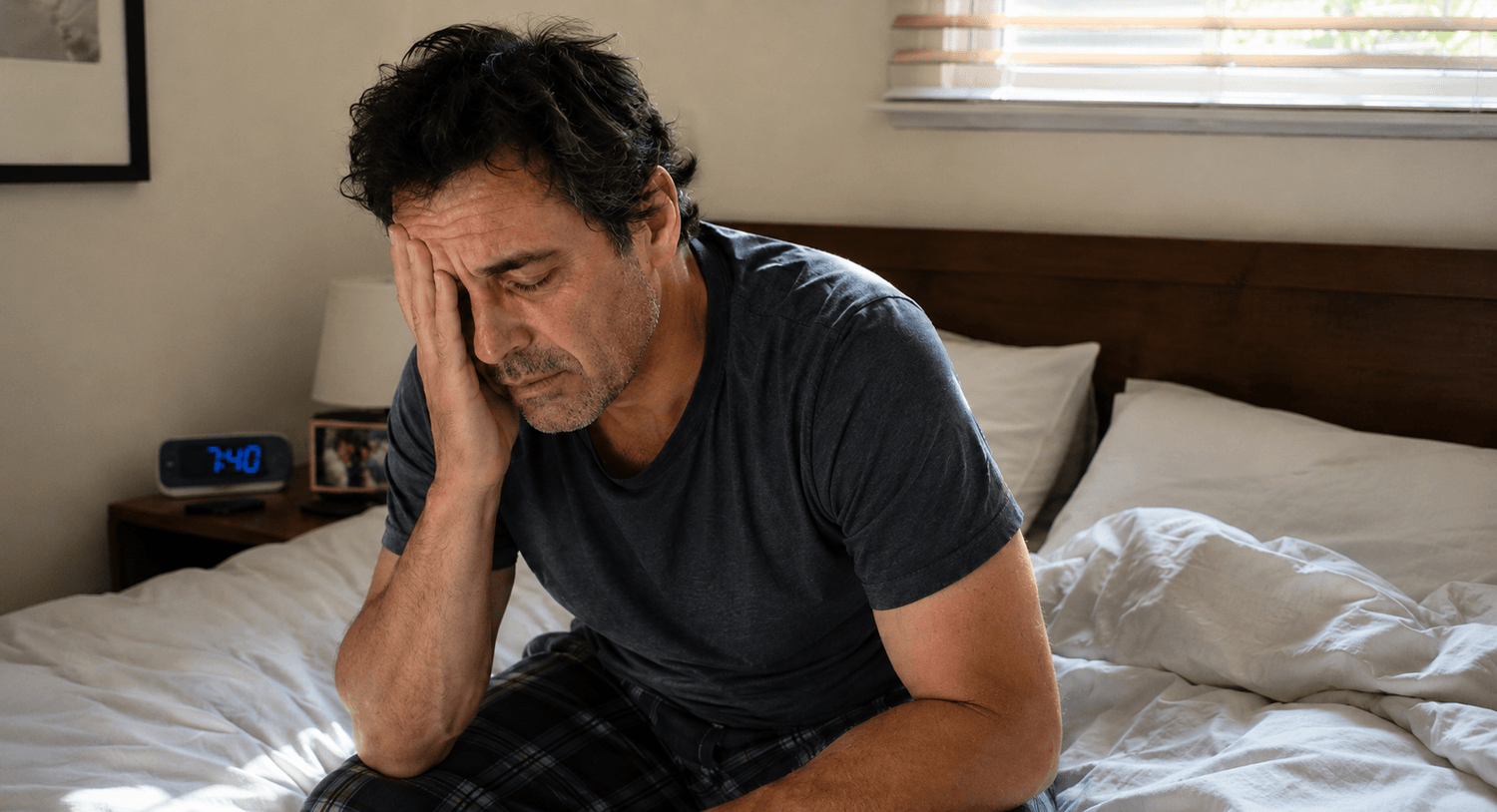
Photo: A common morning experience for the 80 million Americans who wake up with neck or shoulder pain.
I Thought I Was Just “Getting Older.” The Truth Was Much More Serious.
I'm going to tell you something I'm a little embarrassed to admit.
For almost three years, I knew something was wrong with how I was sleeping — and I did nothing about it.
I'm Michael. I'm 54 years old, I work as a regional sales manager in Nashville, Tennessee, and I am, as my wife will happily confirm, the kind of person who doesn't go to the doctor unless something is visibly broken.
The signs were all there. I was exhausted every morning no matter how much I slept. I had a foggy, underwater feeling in my brain for the first two hours of every workday that coffee barely touched. My memory wasn't what it used to be. I'd walk into a room and forget why I was there. I'd lose track of conversations mid-sentence.
I told myself it was stress. It was the job. It was getting older. It was life.
My wife, Carol, knew better. She'd been watching me sleep for years.
1
How It Started
It was a Tuesday night in February about eighteen months ago.
Carol woke up at around 2am. She said she'd been lying there listening to me snore for about an hour — which was apparently normal — when the snoring just stopped. Complete silence. She waited. Five seconds. Ten seconds. Fifteen.
She said she sat up in bed and put her hand on my chest to feel if I was breathing.
I wasn't. Not for what she estimated was close to twenty seconds.
Then I gasped — a loud, sudden intake of breath — rolled over, and went back to snoring. I had no idea any of it had happened.
She woke me up immediately. I remember being disoriented, confused, and a little annoyed at being woken up at 2am. She was shaking.
She made me promise to see a doctor the next day. And for once in my life, I didn't argue.
$3,200+ / year
Between doctor visits, sleep tests, CPAP equipment, and failed products, sleep apnea became an expensive problem fast.
I started falling asleep on the couch because I was afraid of keeping my wife awake all night.
⚡ Sound familiar? See the pillow Michael says made sleeping with sleep apnea feel manageable again — or return it within 60 nights for a full refund.
2
Everything I Tried
(And Why It Didn't Last)
My primary care doctor ordered a home sleep study — one of those kits they send to your house where you sleep with a monitor on your finger and a sensor on your chest for a night.
The results came back within a week.
Moderate obstructive sleep apnea. An AHI — apnea-hypopnea index, which measures how many times per hour your breathing is disrupted — of 22.
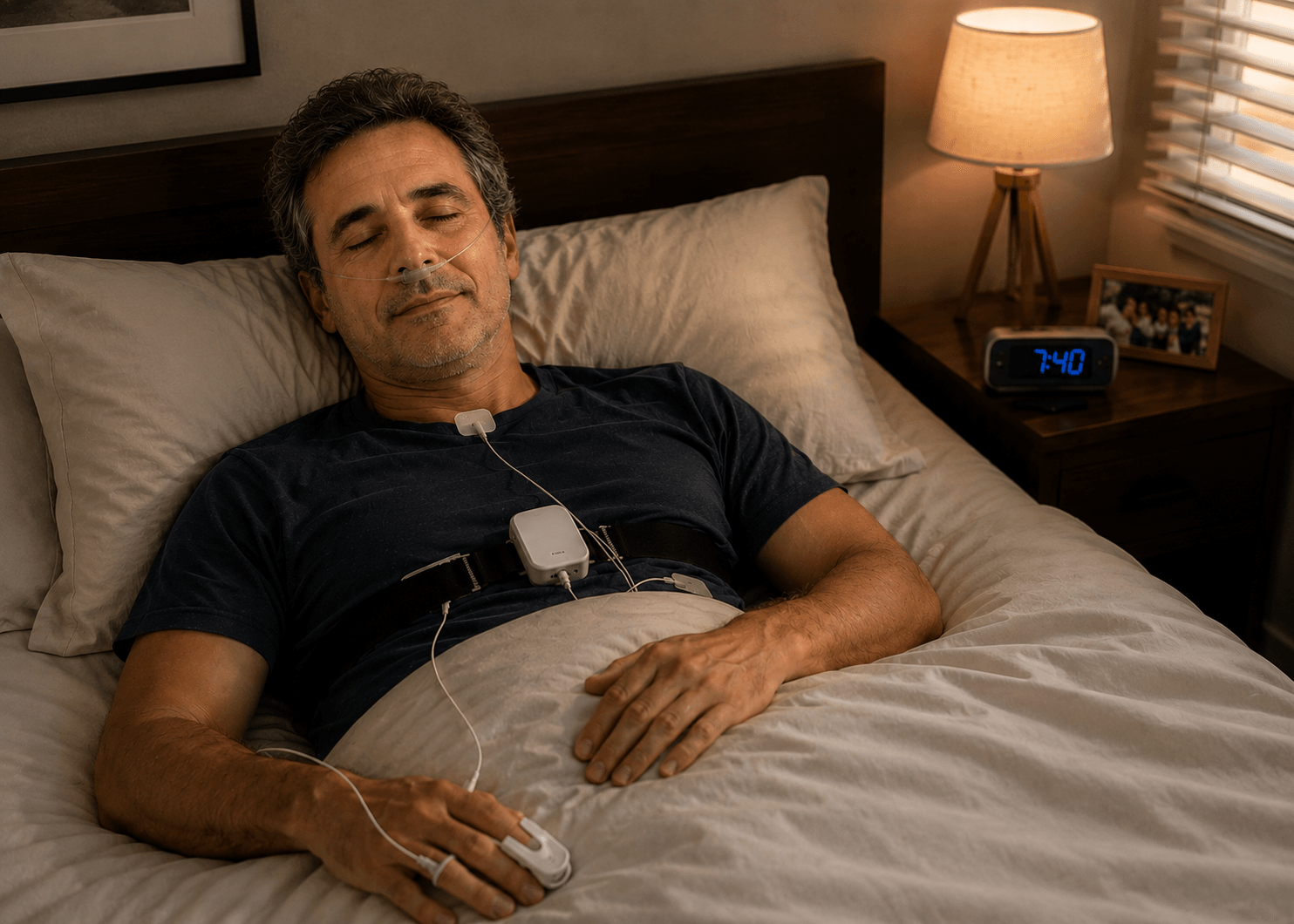
"I had a home sleep study, monitoring my sleep for a week."
Which means my breathing was being interrupted, on average, 22 times every hour I slept. Nearly once every three minutes.
The doctor explained what that meant: every time my airway collapsed and my brain triggered a partial awakening to restore breathing, I was being yanked out of the deeper stages of sleep. Not fully awake — just enough that I'd never complete a full restorative sleep cycle. Night after night after night for years.
That explained everything. The exhaustion. The fog. The memory issues. The feeling of running on empty no matter how early I went to bed.
The recommended treatment was straightforward: CPAP therapy. A machine that pushes a continuous stream of air through a mask to keep the airway open during sleep.
I went home, researched it, and bought one.
Why CPAP Therapy Failed for Me
I want to be clear: CPAP therapy works. For many people with sleep apnea, especially severe cases, it's genuinely life-changing and there's no comparable alternative.
But for me, it was six weeks of misery.
The mask itself wasn't the worst part — though wearing something strapped to your face all night takes serious getting used to. The worst part was the pressure. The machine pushes air continuously, which means you're always breathing against a stream of air, even when you're exhaling. It felt unnatural in a way my brain refused to accept as normal no matter how many nights I tried.
I'd fall asleep with the mask on. Two hours later I'd wake up having pulled it off in my sleep, with no memory of doing it. The machine logged my usage — and my compliance numbers were terrible. Some nights I was only managing an hour of actual CPAP use before my sleeping brain rejected it.
My follow-up appointment with the sleep specialist was not encouraging. She adjusted the pressure settings. She recommended a different mask style. She was patient and professional and genuinely trying to help.
But she also mentioned something almost in passing that stayed with me. She said that my sleep study showed a strong positional component to my apnea — meaning my breathing disruptions were significantly worse when I was sleeping on my back versus my side. She said that for patients like me, positional therapy was sometimes worth exploring alongside or even before escalating CPAP settings.
I went home that night and started researching positional therapy for sleep apnea.
3
What My ChatGPT Told Me
The Research That Changed Everything
What I learned over the next several evenings of reading changed how I thought about the whole problem.
The research on positional sleep apnea is compelling. When the head tilts even slightly backward during sleep, the base of the tongue and the soft palate fall toward the back of the throat, partially or completely blocking the airway. This is why back sleeping is almost universally worse for apnea sufferers — and why the old advice of "sew a tennis ball to the back of your pajamas" actually had some scientific basis, even if the implementation was ridiculous.
But what I hadn't understood before was how much of this positional problem is driven by the pillow.
Most pillows — including memory foam ones — don't actually maintain the neutral head-neck alignment required to keep the airway open consistently. They compress differently as you shift positions. The height and angle of your head at midnight is genuinely different from what it was when you fell asleep. And every time that angle changes in a way that drops your chin toward your chest or lets your head fall back, your airway geometry changes with it.
I found several references to contoured cervical support pillows designed specifically to address this — pillows with different support zones engineered to maintain neutral alignment whether you're sleeping on your back or your side. One kept coming up consistently in the research and in user reviews: Derila Ergo.
I read through the design specs. The contoured butterfly shape, the shoulder arch release zone, the high-density foam with shape retention. It addressed, at least in theory, exactly what my sleep specialist had described as the positional component of my apnea.
Carol ordered it that same night.
4
The First Two Weeks —
Night by Night
N1
Night 1 — Not sure yet
I'll be honest: the first night I noticed nothing dramatic.
The pillow felt different — the shape takes adjustment, especially coming from a standard flat pillow.
M2
Morning 2 — I was confused
I woke up the second morning thinking I'd made another expensive mistake.
M3
Morning 3 — Something is different
The third morning was different. I woke up and lay in bed for a moment, taking inventory the way you do when you've been sick for a long time and you're checking whether you feel better.
My head was clear. Not "clear after two cups of coffee" clear. Clear immediately, the way it used to feel twenty years ago.
I got up without hitting the snooze button. I made coffee out of habit and drank half of it before realizing I didn't actually need it to function.
Carol said I hadn't snored at all the night before — or if I had, not loud enough to wake her.
W1
End of Week 1
By the end of the first week, she was sleeping through the night consistently.
W2
End of Week 2
By the end of the second week, I was waking up before my alarm and actually feeling rested when I opened my eyes — something I genuinely could not remember experiencing in years.
5
Three Months Later — What's Actually Different
I had a follow-up sleep study scheduled three months after my initial diagnosis.
I almost cancelled it. I felt so much better that I didn't want to jinx anything, and part of me didn't want a medical result that contradicted what I was experiencing.
I went anyway.
My AHI — remember, 22 at diagnosis — came back at 6. Anything below 5 is considered normal. Anything between 5 and 15 is mild. I had gone from moderate to the lower end of mild in three months, sleeping on a different pillow.
My sleep specialist reviewed the results and asked what I'd changed. I told her about the pillow and the positional approach. She said she wasn't surprised — she'd seen positional interventions produce significant results in patients with strong positional components to their apnea, as mine clearly had. She said to continue what I was doing and schedule another study in six months.
I'm not going to claim that a pillow cured my sleep apnea. I don't know if my numbers will stay where they are or if I'll eventually need additional intervention. What I know is that right now, five months in, I am sleeping better than I have in at least a decade.
My brain fog is gone. My memory is sharper. My energy before noon is something I'd actually forgotten was possible. My blood pressure at my last physical was the lowest it's been in eight years — my doctor asked if I'd changed my diet.
Carol sleeps in our bedroom now. She stopped wearing earplugs three months ago. She told me last week that she doesn't remember the last time she woke up in the middle of the night.

The strangest thing is how I feel about going to bed now. I used to dread falling asleep — wondering if I’d wake up exhausted, foggy, and feeling like I barely slept at all. Now I actually look forward to bedtime because for the first time in years, I feel like I’m truly resting. That might sound like a small thing. It isn’t.
6
The Pillow I Now Recommend to Everyone
I've recommended Derila Ergo to four people since then — my brother-in-law who has been avoiding a sleep apnea diagnosis for two years, a colleague who mentioned he was always exhausted, and two friends whose wives had told them the same thing Carol told me before I got tested.
I tell all of them the same thing I'll tell you:
I'm not saying this replaces medical care. If you suspect you have sleep apnea, get evaluated. Severe apnea requires proper treatment and that conversation needs to happen with a doctor.
But if you've been diagnosed with mild to moderate sleep apnea and you've struggled with CPAP — or if you have the symptoms and you're not ready for a full sleep study yet — addressing how your head and neck are supported during sleep is the most logical first step I found. And for me, it was the step that made everything else better.
The pillow is currently on sale at 70% off the regular price, with free shipping and a 60-day money-back guarantee. Which means two full months to find out whether it changes things for you — with zero financial risk if it doesn't.
Given what three years of unmanaged sleep apnea cost me in energy, productivity, and health — $59.99 and sixty nights is nothing.
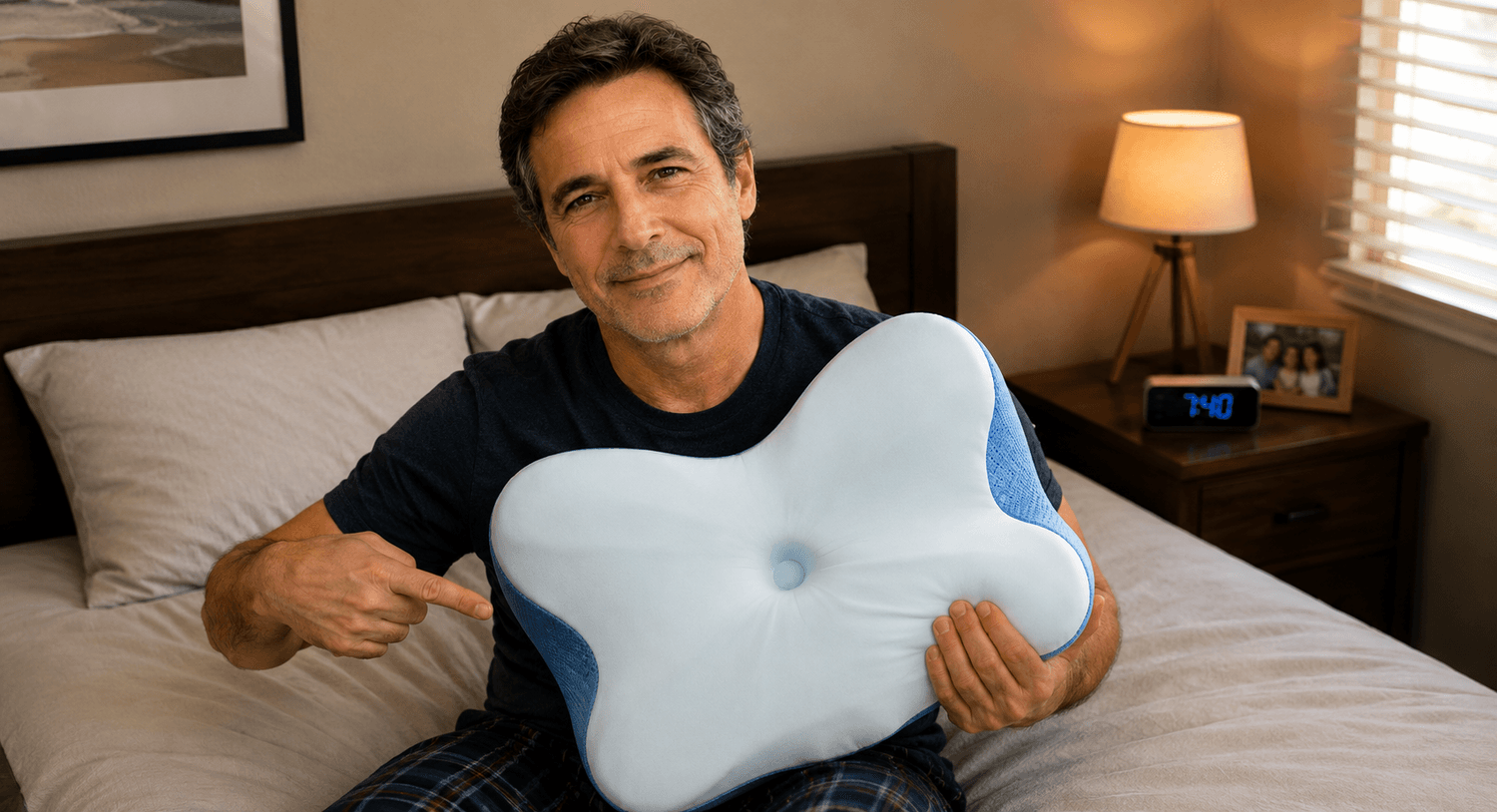
Derila Ergo Memory Foam Pillow
Ergonomic Design
High-Density Foam
70% OFF Today
60-Night Trial
Designed to support healthier nighttime breathing and more comfortable sleep, this pillow is currently available with a significant discount and a full 60-day money-back guarantee. Either it helps improve your sleep quality — or you return it and pay nothing.
If You Wake Up Exhausted Every Morning, This Is Worth Trying
The worst case: you return it and pay nothing. The best case: what happened to me.
🔒 Currently 70% OFF + Free Shipping + 60-Night Money-Back Guarantee
Still on the fence? I understand. I spent three years telling myself I'd deal with it later.
The 60-night guarantee means you have nothing to lose by trying it now. Two months. If your sleep, your energy, and your morning clarity don't genuinely improve — return it, pay nothing, and you're exactly where you started.
If they do improve — and based on the research and my own experience, there's a real chance they will — you'll wonder why you waited.
Important: Sleep apnea is a serious medical condition. This article reflects one person's personal experience with mild to moderate positional sleep apnea and is not intended as medical advice. If you suspect you have sleep apnea, please consult a qualified healthcare provider.
✓ Free Shipping · ✓ 60-Day Guarantee · ✓ Secure Checkout
Disclosure: This post may contain affiliate links. I may receive a small commission if you purchase through my links, at no additional cost to you. My experience and opinions are entirely my own. This is not medical advice — please consult your doctor if you have chronic pain.
© 2026 puresleepmethod.com · Independent Sleep & Wellness Research · Privacy Policy · Affiliate Disclosure